Allen Schmaltz

Computer Scientist
Co-Founder, Reexpress AI, Inc.
Bio
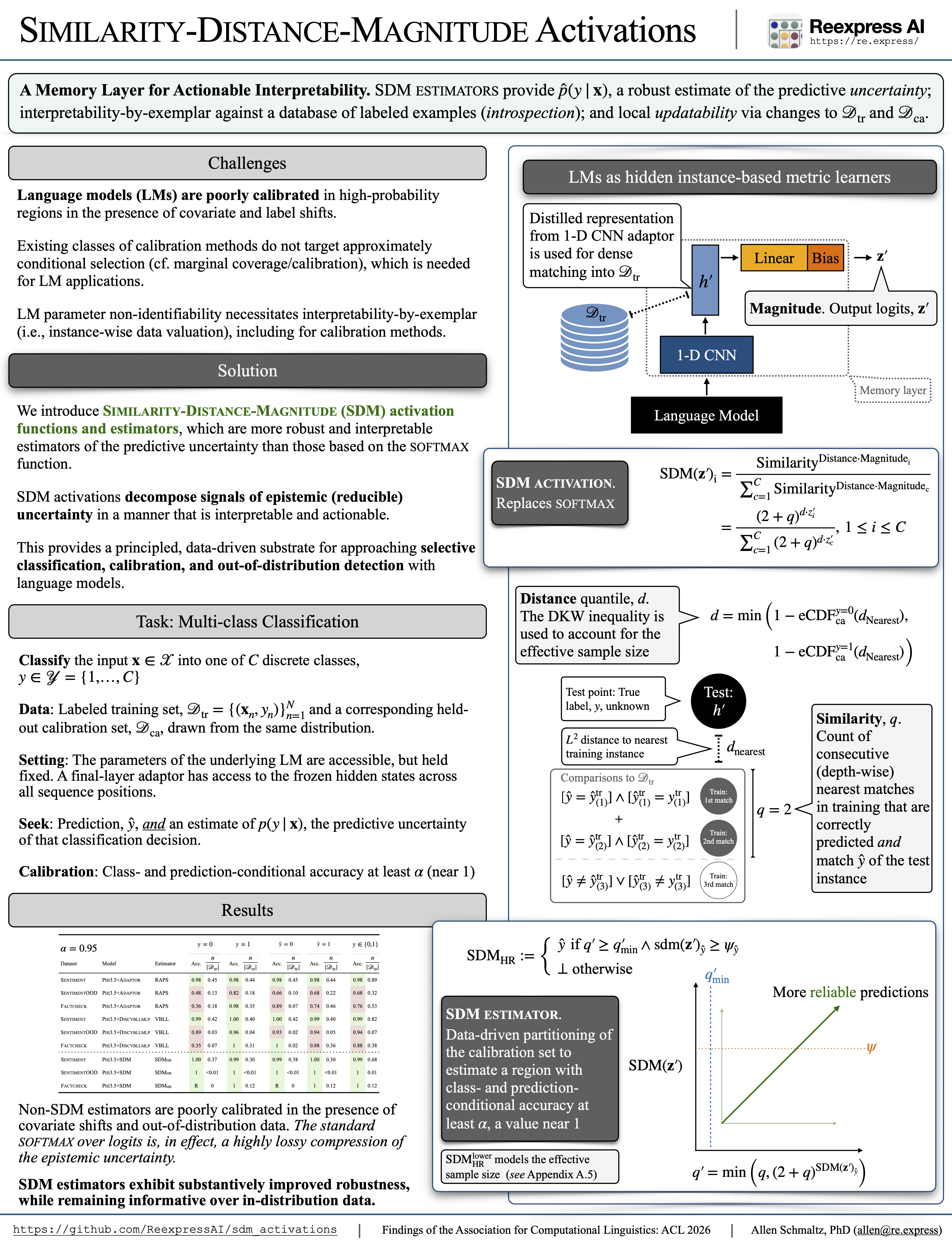
My work at Reexpress AI is focused on scaling Similarity-Distance-Magnitude (SDM) activation functions and SDM estimators to build reliable, robust, and controllable AI systems.
This line of work is based on a novel decoupling of the sources of epistemic (reducible) uncertainty for high-dimensional models via a new activation function that adds Similarity (i.e., correctly predicted depth-matches into training)-awareness and Distance-to-training-distribution-awareness to the existing output Magnitude (i.e., decision-boundary)-awareness of the softmax function. Conceptually this new function is:
\[\rm{SDM}(\mathbf{z})_i = \frac{ {\rm{Similarity}}^{\rm{Distance} \cdot \rm{Magnitude}_i} }{ \sum^C_{c=1} { {\rm{Similarity}}^{\rm{Distance} \cdot \rm{Magnitude}_c} } }\]with a corresponding negative log likelihood loss that takes into account the instance-wise change-of-base.
This enables constructing robust estimators of the predictive uncertainty over models with non-identifiable parameters, such as neural networks, and by extension, building sequence prediction models with robust output verification and interpretability-by-exemplar as intrinsic properties.
This work reflects the evolution of, and lessons learned from, explainable and interpretable AI over the last decade, from early endogenous modeling of explanations with language models as classifiers (Schmaltz et al., 2016), to actionable notions of interpretability by analyzing neural networks as decomposable, hidden instance-based metric learners (Schmaltz, 2021), and finally, to robust, interpretable estimators of the predictive uncertainty (Schmaltz, 2026).
In short, modeling neural networks in this way enables Actionable Interpretability: Introspection of the predictions against instances with known labels; local updatability of conditional-branching decisions without a full re-training (as a mechanism complementary to in-context learning, retrieval, and tool-calling); and robust estimators of the predictive uncertainty.
A brief video overview of this line of work is available here.